
Before this summer, operating the Bainbridge, Ohio water network meant driving between three sites, starting and stopping pumps by hand, and discovering problems after they had grown. The system was commissioned on July 30 after a full bench validation the day before, and the driving is over.
Three sites, one private loop
The network is a textbook small system. A well field with two pumps feeds a buried 20,000 gallon chlorine contact tank at the plant, and two transfer pumps lift finished water to a 330,000 gallon ground storage tank that gravity-feeds the distribution system.
Each remote site got a NEURO. The plant got the CORTEX master. A single private radio loop links the three, and that is the whole communications bill: no carrier contract, no SIM card and no monthly fee anywhere in the system.
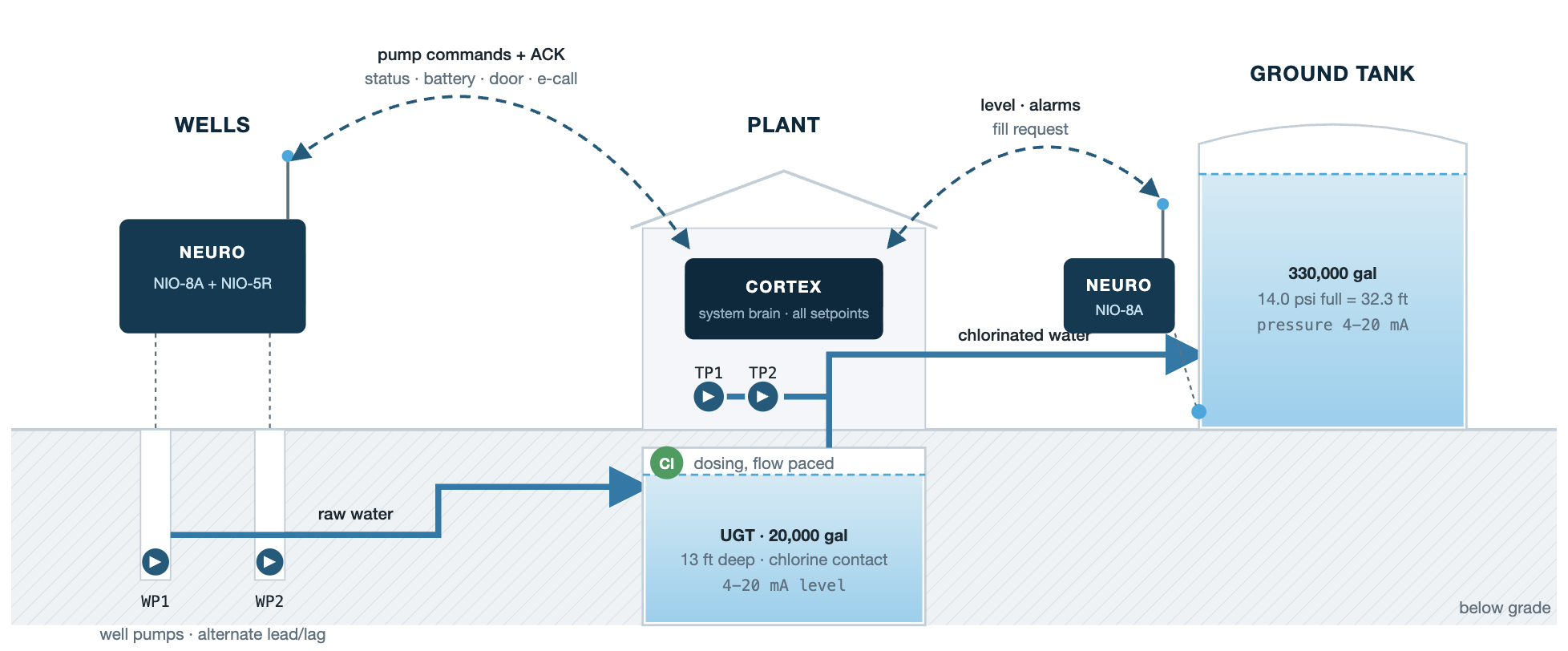
Wells to distribution: radio above grade, water below.
The fill cascade runs itself
The control logic, designed by our consulting engineer LeRoy Shipley, reads like the water flows. The ground tank calls for water and a transfer pump starts. The buried tank drops and the wells are called. The wells refill it through the chlorinator, with dosing paced to the measured flow. Everything fills, everything rests, and each pump pair swaps its lead so wear stays even.
The plant polls both remote sites continuously, eleven readings deep, and every alarm decision is taken in one place. If a radio link ever drops, each site keeps its own thresholds and carries on alone: supervision degrades gracefully instead of disappearing.
Rehearsed before it was installed
The full system ran on the bench before anything went to site. Pump alternation, failovers and power cuts were replayed on the real hardware on July 29, with the logs read line by line. Commissioning the next day was uneventful, which is the point. The crew then spent the following week on site, tuning thresholds against real tank behavior.
Bainbridge owns its system
The logic lives in the units, readable and documented, not locked in a proprietary black box. Configurations are stored on a USB key and reload in seconds, so a spare unit can be pre-programmed for any site. The operators keep a live view of every level, flow and pump from the plant, with the call-out list handled automatically when a human is actually needed.
If your network still runs on windshield time, this is the size of project we like best.